
Custom Rigid Boxes vs Folding Cartons: Which Is Better for Your Product?
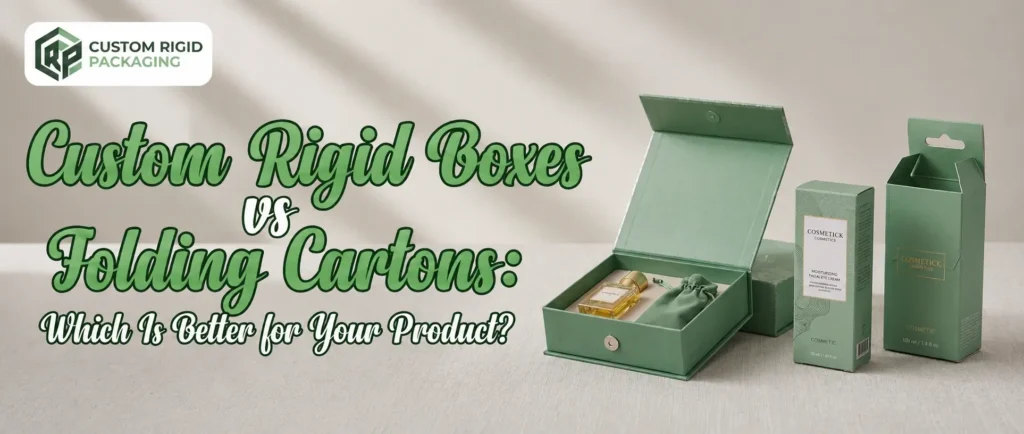
The first point of interaction between any brand and its valued customers is the packaging. The box that you send your product in holds equally as much importance nowadays as the product itself. The box not only holds the products but also leaves a first impression of the brand. But the confusion arises when you, as a brand owner, are not sure which type of box will be best for your product packaging. There are many different types of boxes available in the market. Most people don’t know when to choose from rigid boxes or folding cartons. In this blog, you will get to know about these boxes and which one you should choose depending on the product type.
Key Differences: Rigid Boxes vs Folding Cartons
Here are a few key differences between the two types of boxes before getting into the details of the boxes:
| Feature | Custom Rigid Boxes | Folding Cartons |
|---|---|---|
| Price | Higher initial cost with premium value. | Lower cost and ideal for high-volume packaging. |
| Strength | Very strong and durable; resists crushing and deformation. | Less rigid and better suited for lightweight products. |
| Storage | Requires more storage space because it is usually pre-assembled. | Shipped and stored flat, requiring minimal space. |
| Shipment Structure | Typically delivered pre-assembled and ready to use. | Delivered flat for efficient shipping and assembly. |
| Environmental Impact | Reusable, durable, and commonly made from recyclable paperboard. | Highly recyclable, biodegradable, and suitable for sustainable packaging. |
What Are Custom Rigid Boxes?
Custom Rigid Boxes are made of thick, non-bendable greyboard or chipboard. They are also known as set-up boxes. They have a strong structure and don’t collapse easily. They are shipped in assembled form, and thus, they occupy more space in the warehouse. The structure of this box is ideal for luxury products and items. This makes the unboxing experience memorable and worth it for the customers. Many people also reuse their boxes to store other products. So, the customized boxes remain in the homes of your customers. This is a very strong point for considering these boxes, as this is a form of marketing and free branding for your business. They are mostly used for expensive cosmetics, jewelry, or boutiques.
The Materials They Are Made Of
These boxes are thicker than the regular ones and much stronger because of the materials that they are made of. They are made of the following layers:
The Core:
The core of these boxes is made of chipboard or greyboard and has a thickness of 1 to 3 mm, which is almost 800 to 3000 GSM.
Wrapping:
This is the part where customization and branding are done, and it can be high-quality art paper or textured paper.
Inserts:
Some brands use customized inserts, such as foam inserts, or use rigid boxes with inserts.
Types Of Rigid Boxes
There are different types of rigid boxes depending on their structure. A few of these types are:
- Two-piece boxes:
Two-piece rigid boxes consist of one lid and a separate base; thus, the name two-piece boxes.
- Magnetic closure boxes:
Custom rigid magnetic boxes are made with a magnetic closure lid for a secure closing.
- Drawer boxes:
These boxes are made in such a way that they have a drawer that slides out and holds the products.
- Shoulder-neck boxes:
This box has a raised inner edge on which the lid rests when closed.
- Book-style boxes:
These boxes are for luxurious and limited-edition products. They are in the form of a book and give an elegant look.
What Are Folding Cartons?
Folding cartons or boxes are highly cost-effective packaging solutions made in such a way that they are shipped flat to the factories. They are then arranged by following the pre-creased lines. They occupy very little space in the warehouse as they are assembled when packaging is to be done. They are very lightweight and best for electronic items, cereals, and other products such as medicines.
Materials Used To Make These
These boxes are less thin as compared to rigid boxes, but they are made with good-quality material. The following materials are used to make these boxes:
Solid Bleached Sulfate:
Premium white paperboard that is best for vivid color printing in cosmetics and food.
Coated Unbleached Kraft:
Brown wood fiber is ideal for heavy and rustic items.
Clay-coated News Back:
This is a recycled paperboard that is best for everyday consumer goods.
Types Of Folding Cartons
There are different types of folding cartons, such as the following:
- Tuck-end cartoons:
These types of boxes use flaps to get closed without any tape or glue, such as straight tuck end (STE) or reverse tuck end (RTE).
- Bottom-closure cartons:
These boxes have a stronger bottom for holding heavy products and fragile items.
- Seal-end cartons:
They have plain and untucked flaps at both ends that are designed to be glued or heat-sealed.
- Sleeve cartons:
These are special cardboard boxes that slide over trays and give an elegant look to the products.
- Specialized cartons:
These include special cartons that are made for special products. These include window cartons, gable top cartons, and many more.
Customization In Both
Different types of customization are available for both rigid boxes and folded cartons.
Printing
Both types of boxes can be printed with different customized designs, but the only difference is that when printing is done for rigid boxes, it involves one extra step, as the printing will be done on the wrapping paper. The following printing techniques are usually used:
- Offset printing
- Digital printing
- Screen printing
Add-ons
When you want to order rigid gift boxes or even folding cartons, many people ask for extra options such as ribbons or different add-ons. The following types of finishing and add-ons are usually available:
- Foil stamping
- Blind embossing
- Spot UV
- Lift ribbon
- Magnetic closures
- Wax seals
Packaging Comparison For Different Products
Here is the recommendation on which type of box you should choose based on the type of product:
| Product | Rigid Boxes | Folding Cartons |
|---|---|---|
| Mobile Phones & Electronics | Highly suitable due to superior protection and premium presentation. | Not recommended for high-value electronic products. |
| Cosmetics & Skincare | Ideal for luxury cosmetic and skincare collections. | Suitable for individual creams, lotions, and skincare products. |
| Cereals & Dry Fruits | Less economical for everyday food packaging. | More practical and cost-effective for food products. |
| High-End Jewelry & Watches | Strongly recommended for a luxurious presentation and product protection. | Not ideal, as it offers a standard appearance. |
| Vitamins & Medicines | Generally not recommended due to higher packaging costs. | Preferred for pharmaceutical packaging and regulatory information printing. |
| Apparel & Clothing | Best for luxury fashion, designer wear, and premium gifting. | Suitable for standard apparel and everyday clothing. |
Which One Should You Choose?
Now, you have seen all the details about both types of boxes. Which one is best for you highly depends on your needs. You can see the tale and see which one is best according to your products.
If you want to sell luxury items and specialize in those that are limited editions, rigid boxes are the best choice for you.
However, if you have limited space in the warehouse or you are just a startup, you should choose folding cartons, as they can be customized and are also reliable. They also give a decent look to your products.
The final recommendation is that you should check your resources, review the pros and cons, and then choose the best option.